Django
2021
How to Simplify Django Migrations and Deployment
When removing fields from Django models, or adding non-nullable fields, it can be hard to avoid a mismatch between code running on some servers and the database in use.

Python, Django, and React Development on Apple Silicon
Last year, Apple announced that they would transition their entire Mac line from Intel processors to their ARM64 Apple Silicon chip called the M1. Several weeks ago, I started testing development on MacBook Air with the Apple M1 chip (pictured above).

Our Top 20 Blogs in 2020
We’ve published summaries of our most popular blog posts before (see Top 19 of 2019 and Top 18 of 2018), but this time, we’re taking it a step further. We’re sharing the 20 most popular posts in 2020, regardless of the year the post was originally published. And some of these have been around a while! Based on total pageviews, here are the blogs that rose to the top of the popularity list, from most viewed to least viewed.
2020

My Favorite Technical Blogs and Mailing Lists
I keep up with what's happening in my field by following a number of blogs and an occasional email list. I don't read everything posted in all of these, but by scanning the topics in a feed reader, I can keep up with what's going on, without wasting a lot of time.

A Quick Guide to Generating Fake Data with Pandas
Last August, our CTO Colin Copeland wrote about how to import multiple Excel files in your Django project using pandas. We have used pandas on multiple Python-based projects at Caktus and are adopting it more widely.

Our Top 19 Blogs of 2019
During the last year we gave our popular technical blog an official name: Developer Access. We published 32 posts on the blog, including technical how-to’s, conference information, web development best practices and detailed guides. Among all those posts, 19 rose to the top of the popularity list (based on total pageviews):
2019

Single Page Application + REST as an Abstraction: The Benefits of Decoupling Your Front & Back Ends
Monolithic, consolidated applications are not bad. These are your Rails apps, your Django apps, etc. — the ones where your server sends back HTML and assets. You’ve faithfully followed the Model-View-Controller (MVC) pattern as best you can and your concerns are “separated.” This design principle is not passé. It just so happens that for a long time, it was your only option.

One Team’s Development Patterns With Vue.js and Django REST Framework
Within the past year, my development team at Caktus worked on a project that required a front-end framework to build a fast, easy-to-use product for a client. After a discussion of frameworks such as React, Vue, and Angular, and their approaches, our team settled on using Vue.js, along with a Django back-end with Django REST Framework (DRF). Initially, we chose Vue because we were more familiar with it, rather than its current competitor React, but as we worked on the product, we ended up having a number of team discussions about how to organize our code well and avoid extra code debt. This blog outlines some of the development patterns we chose as we worked through a number of issues, such as simplifying a multitude of almost identical Vuex mutations, finding a consistent way of holding temporary state, and working with nested objects on the front-end and back-end.
DjangoCon 2019 Delivered Again
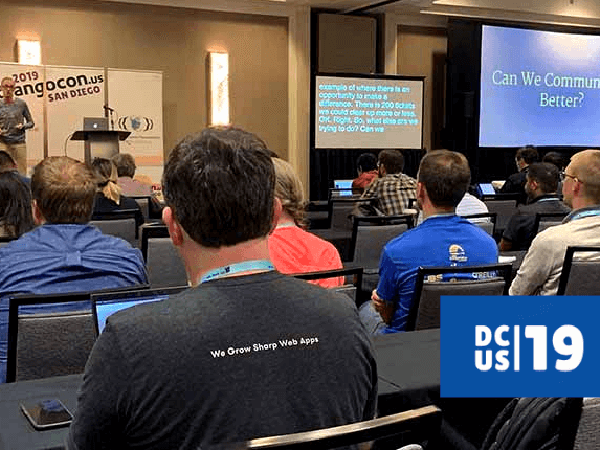
Above: Django Fellow Carlton Gibson gives a talk on “Your Web Framework Needs You: An Update.”
Again this year, DjangoCon more than delivered on its promise of something for everyone. A keynote on burnout and balance? Thoroughly entertaining! Jessica Rose’s talk left us in stitches. Who knew a talk about occupational burnout could be so fun? It was one of a wide range of subjects covered in three days of talks, bookended by a day of tutorials and two days of sprints. The conference took place in San Diego and ran from September 22 - 26. What a great week of learning and networking!
DjangoCon, Here We Come!
We’re looking forward to the international gathering at DjangoCon 2019, in San Diego, CA. The six-day conference, from September 22 - 27, is focused on the Django web framework, and we’re proud to attend as sponsors for the tenth year! We’re also hosting the second annual Caktus Mini Golf event.